
William Shakespeare’s A Midsummer Night’s Dream brings together romance, fairy magic, mistaken identity, and comedy. Its memorable lines explore how unpredictable love can be, how imagination changes the way people see the world, and how easily people become confused by their own feelings.
This collection of 27 A Midsummer Night’s Dream quotes includes famous lines about love, magical descriptions of the forest, funny observations from Puck and Bottom, and thoughtful words about dreams and imagination. Each quote includes the speaker and act-and-scene reference, followed by a short explanation. Shakespeare’s spelling and punctuation may vary slightly between editions, so compare quotations with the edition you use when exact wording matters.
The Course of True Love: Shakespeare’s Greatest Love Quotes
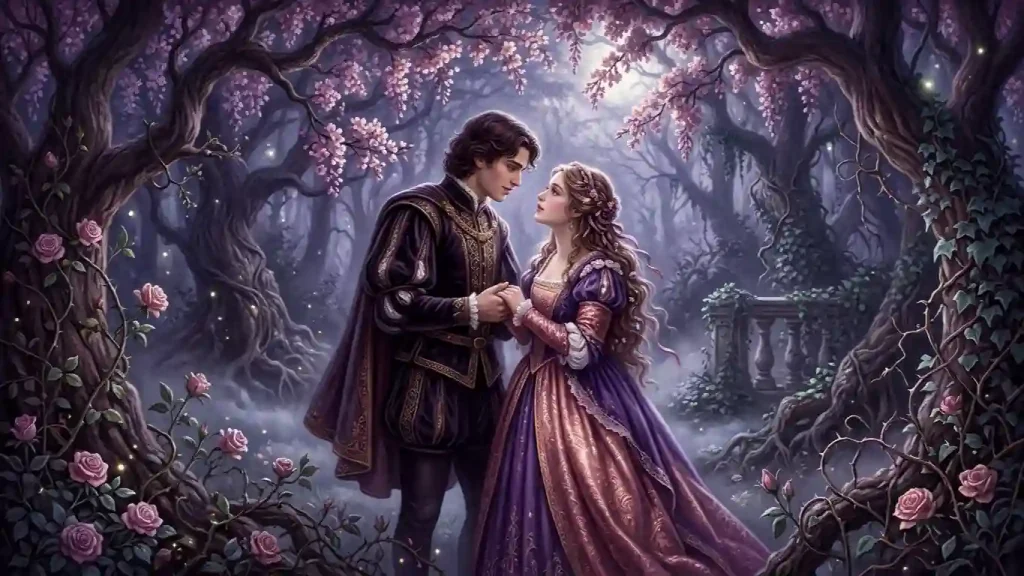
Love is one of the play’s central themes. The four young Athenians experience unreturned affection, jealousy, and sudden changes of heart. These lines show why Shakespeare’s view of love remains relatable.
“The course of true love never did run smooth.”
Lysander, Act 1, Scene 1
Lysander says this while explaining to Hermia why their relationship faces obstacles. Hermia’s father wants her to marry Demetrius, but she wants to marry Lysander. The line remains popular because even sincere relationships can face difficult circumstances.
“Love looks not with the eyes but with the mind;
And therefore is winged Cupid painted blind.”
Helena, Act 1, Scene 1
Helena reflects on how love does not always follow reason or appearances. The image of blind Cupid suggests that affection can overlook flaws and ignore sensible judgment.
“Things base and vile, holding no quantity,
Love can transpose to form and dignity.”
Helena, Act 1, Scene 1
Helena argues that love can change how someone sees another person. Someone who seems ordinary to others may appear admirable to a person in love.
“How happy some o’er other some can be!”
Helena, Act 1, Scene 1
Helena envies Hermia, who is loved by both Lysander and Demetrius. The line captures the pain of comparing your romantic life with someone else’s.
“I’ll follow thee and make a heaven of hell,
To die upon the hand I love so well.”
Helena, Act 2, Scene 1
Helena follows Demetrius into the forest despite his harsh treatment. The line shows the depth of her attachment, but it also reveals the imbalance in their relationship.
“I am your spaniel, and, Demetrius,
The more you beat me I will fawn on you.”
Helena, Act 2, Scene 1
Helena compares herself to a dog that continues to seek affection from an unkind owner. It is an uncomfortable description of unrequited love and shows how desire can lead someone to accept poor treatment.
“So quick bright things come to confusion.”
Lysander, Act 1, Scene 1
Lysander describes how promising relationships can be disrupted. The phrase suggests that beautiful or hopeful things may be fragile, foreshadowing the confusion that overtakes the lovers in the forest.
Love’s Sweet Folly: Quotes About Love and Enchantment
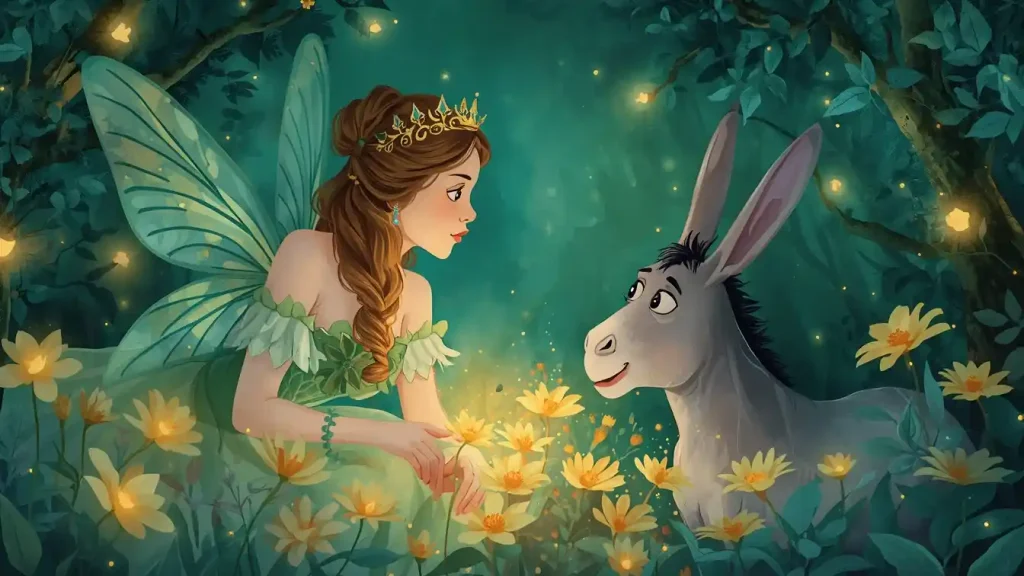
When magic enters the story, feelings become even more unpredictable. A flower’s juice causes people to fall in love with the first creature they see after waking. These lines reveal the comic side of attraction.
“And yet, to say the truth, reason and love keep little company together nowadays.”
Bottom, Act 3, Scene 1
Bottom says this during his strange encounter with Titania, who has been enchanted to love him. His matter-of-fact comment is funny because the situation around him is anything but reasonable.
“What angel woke me from my flow’ry bed?”
Titania, Act 3, Scene 1
Titania wakes and sees Bottom, whose head has been transformed into that of an ass. Because she is under a spell, she sees him as beautiful. The contrast between her romantic language and reality creates a comic moment.
“My mistress with a monster is in love.”
Puck, Act 3, Scene 2
Puck reports Titania’s enchantment to Oberon. The line captures the absurdity of the fairy queen falling for Bottom, while also showing Puck’s delight in the chaos he has helped create.
“My Oberon, what visions have I seen!
I was enamored of an ass.”
Titania, Act 4, Scene 1
After the spell is lifted, Titania remembers her strange experience with embarrassment. The scene is funny, but it also reminds readers that magic has interfered with her choices and feelings.
Fairy Magic: Enchanting Quotes From the Forest
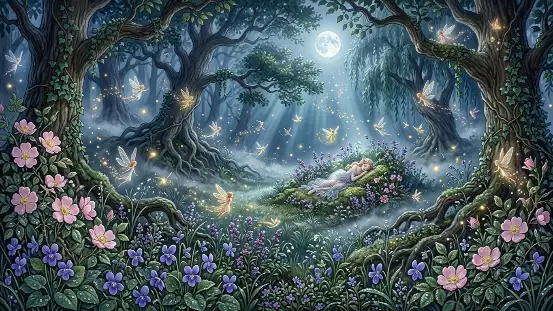
The forest is a place where ordinary rules seem to disappear. Fairies move through the night, flowers become instruments of magic, and sleeping characters wake into unexpected situations.
“I know a bank where the wild thyme blows,
Where oxlips and the nodding violet grows,
Quite overcanopied with luscious woodbine,
With sweet muskroses, and with eglantine.
There sleeps Titania sometime of the night,
Lulled in these flowers with dances and delight.”
Oberon, Act 2, Scene 1
Oberon describes the place where Titania sleeps, creating a picture of a fragrant, flower-filled corner of the forest. The passage gives the fairy world a beauty that contrasts with the quarrels taking place there.
“I must go seek some dewdrops here
And hang a pearl in every cowslip’s ear.”
Fairy, Act 2, Scene 1
A fairy describes gathering dew and imagining each drop as a pearl on a flower. The image makes nature seem delicate and magical.
“I’ll be met by moonlight, proud Titania.”
Oberon, Act 2, Scene 1
Oberon greets Titania with a pointed remark that reveals their disagreement over a young boy whom each wants to keep. The line shows that the fairy world is not free from pride or conflict.
“I am that merry wanderer of the night.”
Puck, Act 2, Scene 1
Puck introduces himself as a mischievous spirit who enjoys tricks and confusion. His words establish his playful character and foreshadow the mistakes he will cause.
“What thou seest when thou dost wake
Do it for thy true love.
Love and languish for his sake.”
Oberon, Act 2, Scene 2
Oberon speaks these words while arranging the enchantment that will make Titania fall in love with the first creature she sees. The rhyme sounds playful, but the spell has major consequences.
“You spotted snakes with double tongue,
Thorny hedgehogs, be not seen.”
First Fairy, Act 2, Scene 2
A fairy sings as part of a charm intended to keep dangerous creatures away from Titania while she sleeps. The words help build the enchanted atmosphere of the forest.
“Now the hungry lion roars,
And the wolf behowls the moon,
Whilst the heavy plowman snores,
All with a weary task foretold.”
Puck, Act 5, Scene 1
Puck describes the night while the human world sleeps. The sounds of animals and the tired plowman create a picture of the countryside settling into darkness.
Puck, Bottom, and the Mechanicals: The Funniest Quotes

Much of the play’s humor comes from Puck’s tricks and Bottom’s confidence. The mechanicals also provide comedy as they prepare a play for the Duke’s wedding celebration.
“Lord, what fools these mortals be!”
Puck, Act 3, Scene 2
Puck says this while watching the lovers’ confusion unfold. The line is funny because he recognizes how foolish the humans appear, even though his own tricks have helped create the mess.
“O, when she is angry, she is keen and shrewd.
She was a vixen when she went to school,
And though she be but little, she is fierce.”
Helena, Act 3, Scene 2
Helena describes Hermia’s fierce temper during their argument in the forest. The final phrase is often quoted on its own to describe someone small but strong-willed.
“Cupid is a knavish lad
Thus to make poor females mad.”
Puck, Act 3, Scene 2
Puck blames Cupid for the lovers’ distress, although Puck himself has helped create the confusion. His remark reflects the play’s habit of treating love as a force that can make people behave irrationally.
“If we offend, it is with our goodwill.”
Quince, Act 5, Scene 1
Quince begins the mechanicals’ prologue with an awkward explanation of their performance. The group wants to reassure the audience, but their wording makes the situation funnier.
Timeless Wisdom: Quotes About Imagination and Dreams
Beyond romance and comedy, the play asks whether dreams and imagination reveal something meaningful about human experience.
“The lunatic, the lover, and the poet
Are of imagination all compact.”
Theseus, Act 5, Scene 1
Theseus groups people considered irrational with poets, whose imaginations help them see beyond ordinary reality. His words express a lasting idea about creativity.
“The poet’s eye, in a fine frenzy rolling,
Doth glance from heaven to Earth, from Earth to heaven;
And as imagination bodies forth
The forms of things unknown, the poet’s pen
Turns them to shapes and gives to airy nothing
A local habitation and a name.”
Theseus, Act 5, Scene 1
Theseus describes how imagination transforms ideas into something people can picture and understand. The speech offers a powerful description of what writers and artists do.
“But all the story of the night told over,
And all their minds transfigured so together,
More witnesseth than fancy’s images
And grows to something of great constancy;
But, howsoever, strange and admirable.”
Hippolyta, Act 5, Scene 1
Hippolyta responds to Theseus’s skepticism about the lovers’ experiences. Because the four young people tell similar stories, she wonders whether their experience can be dismissed as mere imagination.
“I have had a rare vision… The eye of man hath not heard, the ear of man hath not seen, man’s hand is not able to taste, his tongue to conceive, nor his heart to report what my dream was.”
Bottom, Act 4, Scene 1
Bottom struggles to describe his unusual experience after the spell is lifted. He mixes up the senses in a comic version of a serious biblical phrase, making his attempt to explain the dream both absurd and memorable.
“If we shadows have offended,
Think but this and all is mended:
That you have but slumbered here
While these visions did appear.”
Puck, Act 5, Scene 1, Epilogue
Puck addresses the audience at the end of the play. He suggests that if the performance has displeased anyone, they can imagine it was only a dream. The farewell blurs the line between theater and reality.
Short and Famous Midsummer Night’s Dream Quotes
These short lines are useful for captions, classroom notes, presentations, or quote collections. Keep the speaker and context when citing them formally.
- “The course of true love never did run smooth.” Lysander, Act 1, Scene 1
- “Lord, what fools these mortals be!” Puck, Act 3, Scene 2
- “Ill met by moonlight, proud Titania.” Oberon, Act 2, Scene 1
- “What angel wakes me from my flow’ry bed?” Titania, Act 3, Scene 1
- “I am that merry wanderer of the night.” Puck, Act 2, Scene 1
- “And though she be but little, she is fierce.” Helena, Act 3, Scene 2
What Do the Quotes in A Midsummer Night’s Dream Mean?
The play’s famous lines connect its magical plot to familiar human experiences. Love can be irrational, people can misunderstand one another, and imagination can make unlikely things seem possible. Some quotes are romantic, others are comic, and some question whether people can always trust what they see or remember.
When interpreting a quote, consider who says it, what has just happened, and whether the speaker is serious, mistaken, or joking. For example, “Lord, what fools these mortals be!” sounds like a general judgment about humanity, but it comes from Puck, whose tricks helped create the confusion. That context makes the line more ironic.
A Note on Quotes Often Misattributed to This Play
Some familiar Shakespeare quotations are mistakenly associated with A Midsummer Night’s Dream. “All that glisters is not gold” appears in The Merchant of Venice, while “To thine own self be true” is spoken by Polonius in Hamlet. “If music be the food of love, play on” opens Twelfth Night. The phrase “love is blind” is associated with Shakespeare’s writing more broadly, but it is not the exact wording of Helena’s line in this play. Check the play text and edition rather than relying on unattributed quote lists.
Frequently Asked Questions
What is the most famous quote from A Midsummer Night’s Dream?
Two of the best-known lines are “The course of true love never did run smooth,” spoken by Lysander in Act 1, Scene 1, and “Lord, what fools these mortals be!” spoken by Puck in Act 3, Scene 2. The first is about obstacles in love; the second comments humorously on human behavior.
Who says “Lord, what fools these mortals be”?
Puck, also known as Robin Goodfellow, says the line in Act 3, Scene 2. He observes the confusion among the four Athenian lovers, although his own actions have contributed to their problems.
What is the meaning of “The course of true love never did run smooth”?
Lysander means that genuine love often faces obstacles. Hermia and Lysander deal with family opposition and the confusing events in the forest. The line remains relevant because relationships can involve difficulties even when feelings are sincere.
Is “All that glitters is not gold” from A Midsummer Night’s Dream?
No. The line is commonly rendered as “All that glisters is not gold” in The Merchant of Venice, Act 2, Scene 7.
When was A Midsummer Night’s Dream written?
The play is generally dated to the mid-1590s, often around 1595–1596, and it was printed in 1600. The exact composition date is uncertain, so present it as an estimate.
What are the main themes of A Midsummer Night’s Dream?
Major themes include romantic love, jealousy, illusion, dreams, imagination, transformation, and the difference between appearance and reality. Fairy magic and comic misunderstandings reveal how unpredictable people can be.
Why is Puck important in the play?
Puck is a mischievous fairy who serves Oberon. His actions drive much of the confusion, especially when the love potion affects the wrong person. He also speaks directly to the audience in the epilogue.
A Final Word
The lasting appeal of A Midsummer Night’s Dream comes from its mix of romance, humor, fantasy, and insight into human behavior. Its quotes capture the complications of love, the mischief of the fairy world, and the power of imagination.
Whether you are looking for a famous Shakespeare line, studying the play for class, or exploring its deeper themes, reading each quotation with its speaker and scene in mind makes its meaning clearer. These quotes offer a starting point for revisiting one of Shakespeare’s most enchanting comedies and discovering why its words still resonate with readers today.

Mustansar Abbas is a writer and author of the article “LuxaryEditorial” He is passionate about creating meaningful and engaging content that connects with readers through clear ideas and thoughtful expression.

Pingback: Twilight Quotes: 22 Lines Every Fan Will Never Forget