

Hatchet quotes capture the powerful lessons of survival, patience, hope, and self-reliance in Gary Paulsen’s classic novel. Through Brian Robeson’s struggle in the wilderness, readers discover how courage grows through small actions and difficult choices.
First published in 1986, Hatchet follows thirteen-year-old Brian after a plane crash leaves him alone in the Canadian wilderness. With little food, limited supplies, and a hatchet given to him by his mother, Brian must learn to survive. The novel received a Newbery Honor in 1988.
What makes Brian’s story memorable is not simply his fight against hunger, cold, and danger. It is the way he changes. He learns to observe his surroundings, control his fear, solve problems, and keep going when rescue seems unlikely.
This guide explores 20 memorable lines, moments, and lessons from Hatchet. A few short excerpts are quoted directly; the other entries are paraphrased interpretations, not exact words from the novel. If you need quotations for an essay, check the wording and page number in your own edition.
Hatchet Quotes About Survival
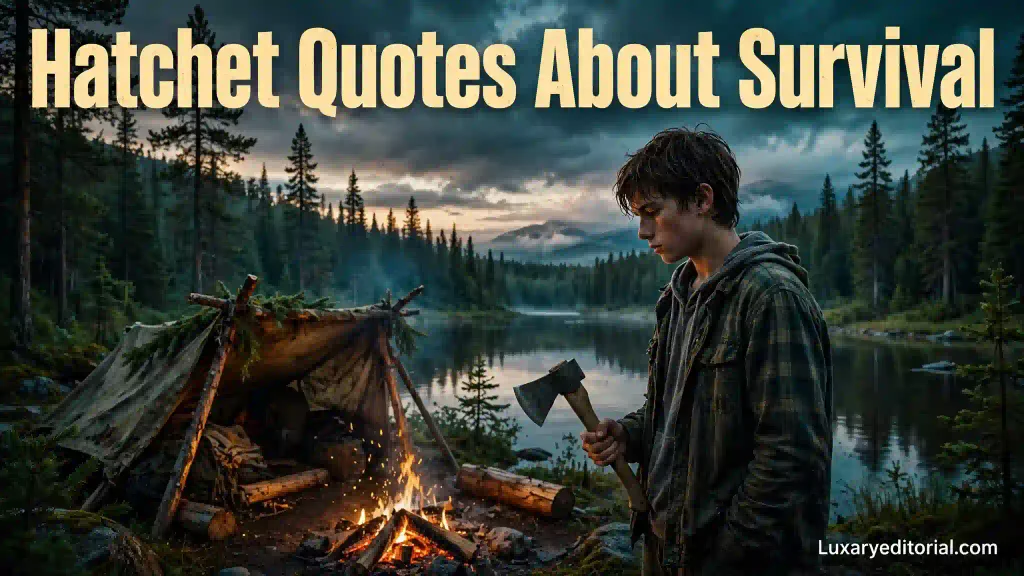
Brian’s first challenge is to understand that surviving requires more than wishing for help. He must learn what his surroundings can offer and make careful choices with the limited tools he has.
1. “Fire. The hatchet was the key to it all.”
Meaning: This brief line connects a simple tool with a major turning point in Brian’s survival. Fire can provide warmth, help prepare food, and make life in the wilderness more manageable.
Life lesson: A small resource can make a major difference when you learn how to use it.
2. Paraphrased lesson: Survival begins with the next small task
After the crash, Brian faces problems that feel too large to solve all at once. He gradually learns to focus on immediate needs, such as finding shelter, getting food, and protecting himself.
Meaning: Breaking a frightening challenge into smaller tasks makes it easier to act.
Life lesson: When a problem feels overwhelming, identify the first useful step instead of trying to solve everything at once.
3. Paraphrased lesson: Your mind is one of your most useful tools
Brian does not begin as an expert outdoorsman. His ability to notice patterns, remember lessons, and change his approach becomes increasingly important.
Meaning: Knowledge and judgment can be just as valuable as physical equipment.
Life lesson: Learn what you can, pay attention, and use your resources carefully.
Hatchet Quotes About Hope and Courage
Hope in Hatchet changes as Brian’s experience grows. At first, he wants someone to rescue him. Over time, he begins to trust his ability to learn and respond to danger.
4. “Tough hope”
Meaning: This short phrase captures a form of hope based on action rather than wishful thinking. Brian begins to believe that what he learns can help him survive.
Life lesson: Hope becomes more useful when you connect it to effort, preparation, and practical choices.
5. Paraphrased lesson: Courage means acting while afraid
Brian experiences fear, loneliness, pain, and moments of despair. He does not become fearless. Instead, he learns to act even when he is uncertain.
Meaning: Courage is not the absence of fear; it is the ability to make a thoughtful choice despite fear.
Life lesson: You do not need complete confidence before taking a reasonable first step.
6. Paraphrased lesson: One difficult day does not define your future
Brian’s circumstances change as he learns new skills. A painful setback does not erase everything he has already learned.
Meaning: A bad day can be part of a longer process rather than the end of it.
Life lesson: Give yourself room to recover, learn, and try again.
Hatchet Quotes About Patience and Clear Thinking
Brian discovers that rushing can make a dangerous situation worse. Careful observation and patience help him understand problems before deciding what to do.
7. Paraphrased lesson: Patience gives you time to think
Brian learns to pause, observe, and consider his options rather than acting on his first reaction.
Meaning: Patience is an active skill. It allows a person to notice details and make better decisions.
Life lesson: When emotions run high, a short pause can help you choose a more useful response.
8. “Just sense.”
Meaning: This brief excerpt reflects the value of practical judgment in Brian’s problem-solving. He must learn to work with the conditions around him rather than rely on guesswork.
Life lesson: Use what you know, examine the evidence, and choose a sensible next step.
9. Paraphrased lesson: Observation can reveal a solution
Brian learns by watching the land, water, animals, and changes in the weather. Careful observation helps him understand which actions are likely to work.
Meaning: Good decisions often begin with noticing details other people might overlook.
Life lesson: Before solving a problem, take time to understand it.
Hatchet Quotes About Self-Reliance

Self-reliance is one of the novel’s central themes. Brian gradually becomes more capable because he practices skills, learns from failure, and takes responsibility for his choices.
10. Paraphrased lesson: Learn to trust your ability to improve
Brian begins with limited survival knowledge, but experience teaches him how to handle new challenges.
Meaning: You do not need to know everything at the beginning. Skills can develop through practice and reflection.
Life lesson: Measure progress by what you learn, not only by what you can do today.
11. Paraphrased lesson: Take responsibility for your next move
Brian cannot control every part of his situation. He can, however, decide how to respond to the problems in front of him.
Meaning: Taking responsibility does not mean blaming yourself for everything that happens. It means recognizing where your choices can make a difference.
Life lesson: Focus your energy on the decisions you can actually influence.
Hatchet Quotes About Nature and Observation
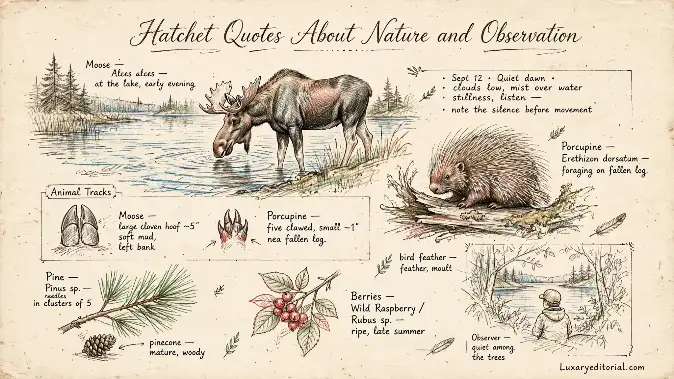
The wilderness is more than a setting in Hatchet. It is an environment Brian must learn to understand. Nature provides resources, but it also presents risks that demand respect.
12. Paraphrased lesson: Listening helps you notice what matters
At first, Brian struggles to understand the unfamiliar sounds and conditions around him. Gradually, he pays closer attention to the world beyond his own thoughts.
Meaning: Observation can help people notice opportunities, warnings, and details they might otherwise miss.
Life lesson: Slow down and pay attention before deciding what a situation means.
13. Paraphrased lesson: Respect the limits of your knowledge
Brian discovers that the wilderness does not follow his wishes. He must learn how things work instead of assuming that nature will cooperate.
Meaning: Confidence should not become carelessness.
Life lesson: Be curious, stay humble, and respect risks you do not fully understand.
Hatchet Quotes About Mistakes and Learning

Brian makes mistakes, but he also learns to use experience to improve his choices. The novel shows that learning can be uncomfortable, especially when a poor decision has serious consequences.
14. “Long tears, self-pity tears, wasted tears.”
Meaning: This short excerpt reflects Brian’s growing awareness that remaining trapped in self-pity will not solve his immediate problems.
Life lesson: Your feelings deserve attention, but when you are ready, a small constructive action can help you move forward.
This lesson should not be confused with the idea that sadness is always unhelpful. Brian’s experience shows the importance of responding to hardship, not pretending that painful feelings do not exist.
15. Paraphrased lesson: Small mistakes can have serious consequences
Brian learns that unfamiliar animals, limited supplies, and dangerous surroundings require care. A seemingly harmless decision can create a larger problem.
Meaning: Understanding risk is part of making responsible choices.
Life lesson: Pause to consider possible consequences, especially when you are in an unfamiliar situation.
16. Paraphrased lesson: Failure can teach you what to change
When a plan fails, Brian has to reconsider his approach. Each experience gives him information that can help him make a better decision next time.
Meaning: Failure becomes useful when you examine what happened and adjust your actions.
Life lesson: Ask yourself what went wrong, what you learned, and what you can try differently.
Hatchet Quotes About Change and Personal Growth
Brian’s survival journey changes his understanding of himself. He becomes more observant, resourceful, and aware of the choices he can make.
17. Paraphrased lesson: Difficult experiences can change your perspective
Before the crash, Brian has problems connected to his family and his parents’ divorce. In the wilderness, his immediate needs force him to see the world differently.
Meaning: New experiences can change which problems seem most important and how a person understands their own abilities.
Life lesson: Growth can begin when you discover that you are capable of more than you expected.
18. Paraphrased lesson: Confidence grows through experience
Brian’s confidence does not appear all at once. It develops as he learns skills and sees the results of his efforts.
Meaning: Confidence is often built through repeated practice rather than positive thinking alone.
Life lesson: Keep track of small improvements. They can help you see how far you have come.
What Does the Hatchet Symbolize?

The hatchet is both a practical tool and an important symbol in the novel. Brian receives it from his mother before the crash, but its meaning changes as he learns to use it.
At first, the hatchet is simply something he has with him. Later, it becomes central to his ability to create fire and manage life in the wilderness. It represents the value of useful tools, learning, and resourcefulness.
The hatchet can also represent Brian’s growing independence. Its importance does not mean that a tool alone saves him. Brian must learn how to use it, recognize its limits, and combine it with careful thinking.
Key takeaway: The hatchet represents potential, but Brian’s choices and growing skills help turn that potential into something useful.
The Most Important Lessons from Hatchet
Readers can take several lessons from Brian’s story. These are interpretations of the novel, not direct quotations.
| Lesson | What Brian’s experience shows |
| Patience | Take time to observe before acting. |
| Resourcefulness | Use available tools carefully and creatively. |
| Courage | You can act thoughtfully even when you feel afraid. |
| Self-reliance | Learn skills and take responsibility for your choices. |
| Adaptability | Change your approach when a plan does not work. |
| Hope | Connect optimism with useful action. |
| Resilience | Recover from setbacks and keep learning. |
| Respect for nature | Understand risks before acting in unfamiliar surroundings. |
These lessons are not a promise that every problem can be solved through effort alone. Brian faces a fictional survival emergency, and real emergencies may require outside help. The broader message is that thoughtful action, learning, and persistence can help people respond to difficult circumstances.
How to Use Hatchet Quotes in an Essay
If you are writing a school assignment about Hatchet, use quotations to support a clear point rather than adding them only because they sound inspiring.
1. Choose a quotation that supports your claim
For an essay about resilience, select a brief passage that connects to Brian’s response to a setback. For an essay about symbolism, focus on a scene involving the hatchet.
2. Explain the context
Identify what is happening in the story when the words appear. A quote becomes easier to understand when readers know what Brian is facing.
3. Analyze the meaning
Explain what the passage reveals about Brian’s thoughts, decisions, or growth. Avoid simply repeating the quotation in different words.
4. Cite the edition you actually read
Page numbers can differ across editions. Use the author, title, and page number required by your teacher or citation style, and verify the wording against your own copy.
Example essay structure
Claim: Brian becomes more resourceful as he learns from experience.
Evidence: Use a short, verified quotation from the edition you read that demonstrates his changing approach to a problem.
Analysis: Explain how the scene shows Brian moving from panic or uncertainty toward careful observation and action.
Connection: Link that change to the novel’s larger theme of self-reliance.
For further background, see the publisher’s book page and the American Library Association’s Hatchet entry.
Frequently Asked Questions About Hatchet Quotes
What is the most famous quote from Hatchet?
The phrase “Tough hope” is a memorable expression associated with Brian’s changing outlook. To quote a full sentence accurately, check your edition of the novel and cite the page number.
What is the main message of Hatchet?
One central message is that people can develop resourcefulness and resilience by learning from experience. Brian’s survival depends on adapting to his surroundings, solving practical problems, and responding to setbacks.
Who wrote Hatchet?
Gary Paulsen wrote Hatchet, a young adult survival novel first published in 1986. The book received a Newbery Honor in 1988. See the American Library Association’s award listing.
What does the hatchet symbolize?
The hatchet symbolizes resourcefulness and growing independence. It is a practical tool, but its importance also reflects Brian’s developing ability to learn and use what he has.
What is the most important survival lesson in Hatchet?
A major lesson is to avoid letting panic control every decision. Brian learns to observe his surroundings, think through problems, and focus on the next useful task.
How does Brian change throughout Hatchet?
Brian grows from a frightened boy with limited survival skills into a more observant and resourceful person. His experiences change how he understands himself and responds to challenges.
Quick Hatchet Quiz
Test your understanding of the novel.
1. Who is the main character in Hatchet?
- A. Gary Paulsen
- B. Brian Robeson
- C. Mr. Perpich
- D. The bush pilot
2. What tool does Brian have after the crash?
- A. A compass
- B. A fishing rod
- C. A hatchet
- D. A pocket radio
3. Which theme is central to the novel?
- A. Self-reliance
- B. Fame
- C. Competition
- D. Time travel
4. How does Brian become more capable?
- A. By avoiding every challenge
- B. By waiting without learning
- C. By learning from experience
- D. By finding every answer immediately
5. What does the hatchet represent beyond its practical use?
- A. Wealth
- B. Resourcefulness and independence
- C. Popularity
- D. Luxury
Answer key: 1-B, 2-C, 3-A, 4-C, 5-B.
Final Thoughts
Hatchet remains memorable because Brian’s story is about more than surviving in the wilderness. It explores the way patience, resourcefulness, and repeated effort can change how a person responds to hardship.
The most useful lessons are often the simplest: pay attention, learn from mistakes, respect risks, and focus on the next step you can take. Brian does not become capable overnight. He grows through experience, and that gradual change gives his story its lasting impact.
If you are studying the novel, use its brief quotations as evidence and your own analysis to explain their meaning. If you are reading for inspiration, remember that resilience does not mean never feeling afraid or asking for help. It means continuing to learn and choosing a constructive response when you can.

Mustansar Abbas is a writer and author of the article “LuxaryEditorial” He is passionate about creating meaningful and engaging content that connects with readers through clear ideas and thoughtful expression.