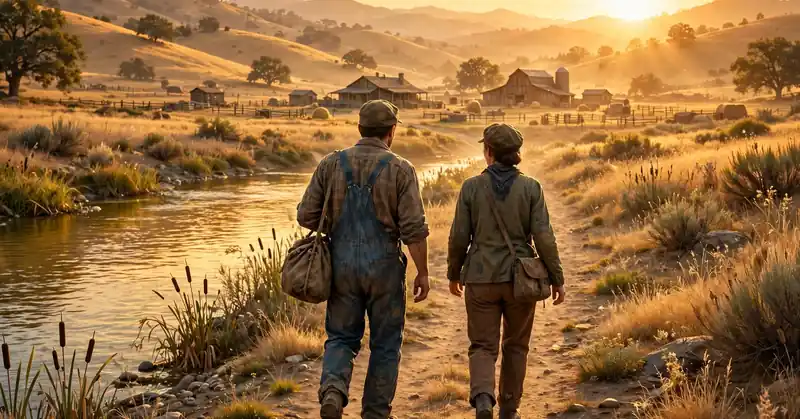
John Steinbeck’s Of Mice and Men, published in 1937, tells the heartbreaking story of two migrant ranch workers, George Milton and Lennie Small, who dream of building a better life together. Their hopes for a small farm reveal the power of friendship, the pain of loneliness, and the cruel gap between dreams and reality.
These Of Mice and Men quotes explore the novella’s most important themes, including the American Dream, loyalty, isolation, discrimination, mercy, and loss. Each selection includes character context and literary analysis to help readers understand why Steinbeck’s words remain meaningful.
Of Mice and Men Quotes About the American Dream

The American Dream promises that hard work can lead to independence, security, and a better future. George and Lennie’s plan to own a small farm represents that hope. However, Steinbeck gradually reveals how difficult it is for vulnerable people to escape poverty and uncertainty.
1. “Guys like us, that work on ranches, are the loneliest guys in the world.”
Speaker: George Milton
Context: Chapter 1
George describes the lonely lives of ranch workers who travel from one job to another without a permanent home or close relationships.
Meaning: The line establishes loneliness as one of the novella’s central themes. George and Lennie are different because they have each other, giving their friendship special importance in a world where most workers face hardship alone.
2. “We got a future. We got somebody to talk to that gives a damn about us.”
Speaker: George Milton
Context: Chapter 1
George explains why his relationship with Lennie gives them something that other ranch workers often lack.
Meaning: Their dream is about more than owning land. It also represents belonging, emotional security, and the hope of living without constant uncertainty.
3. “Someday — we’re gonna get the jack together and we’re gonna have a little house and a couple of acres.”
Speaker: George Milton
Context: The farm dream, Chapter 1
George describes the modest home he and Lennie hope to buy after saving enough money.
Meaning: The small size of their ambition makes the dream especially moving. They do not seek extraordinary wealth. They want a home, enough food, and control over their own lives.
4. “An’ live off the fatta the lan’.”
Speaker: Lennie Small
Context: Chapter 1
Lennie eagerly repeats one of his favorite parts of George’s story about the farm.
Meaning: The phrase captures their desire for freedom from wage labor and dependence on ranch owners. For Lennie, the dream is also about comfort, safety, and the pleasure of caring for rabbits.
5. “I think I knowed from the very first. I think I knowed we’d never do her.”
Speaker: George Milton
Context: Chapter 5
After Curley’s wife dies, George admits to Candy that he had begun to doubt whether their dream would ever come true.
Meaning: The confession reveals that the farm was both a practical goal and an emotional refuge. Repeating the dream gave George and Lennie comfort even when their future was uncertain.
George and Lennie Quotes About Friendship

George and Lennie’s relationship is unusual in the ranch world. Although their friendship brings responsibility and frustration, it also gives them a sense of family. Steinbeck uses their bond to ask whether companionship can protect people from a harsh and unpredictable world.
6. “Ain’t many guys travel around together.”
Speaker: Slim
Context: Chapter 2
Slim notices that George and Lennie work and travel as a pair, something unusual among itinerant ranch hands.
Meaning: His observation shows how rare companionship is in the novella. George and Lennie’s relationship challenges the idea that every worker must survive alone.
7. “I got you to look after me, and you got me to look after you, and that’s why.”
Speaker: Lennie Small
Context: Chapter 1
Lennie explains the mutual responsibility that defines his relationship with George.
Meaning: Their friendship is not simply one person helping another. Each man gives the other a reason to keep going. Lennie depends on George for guidance, while George gains companionship and purpose from caring for Lennie.
8. “Maybe ever’body in the whole damn world is scared of each other.”
Speaker: Slim
Context: Chapter 2
Slim reflects on why people rarely form close connections in their difficult world.
Meaning: Fear prevents people from trusting one another. Steinbeck suggests that loneliness is not always caused by physical separation; it can also grow from suspicion, insecurity, and a lack of compassion.
9. “I could get along so easy and maybe have a girl.”
Speaker: George Milton
Context: Chapter 1
George imagines how simple his life might be if he were traveling alone.
Meaning: This thought reveals the strain of caring for Lennie. Yet George’s continued loyalty shows that their relationship means more to him than the freedom he imagines he could gain without it.
Quotes About Loneliness and Isolation
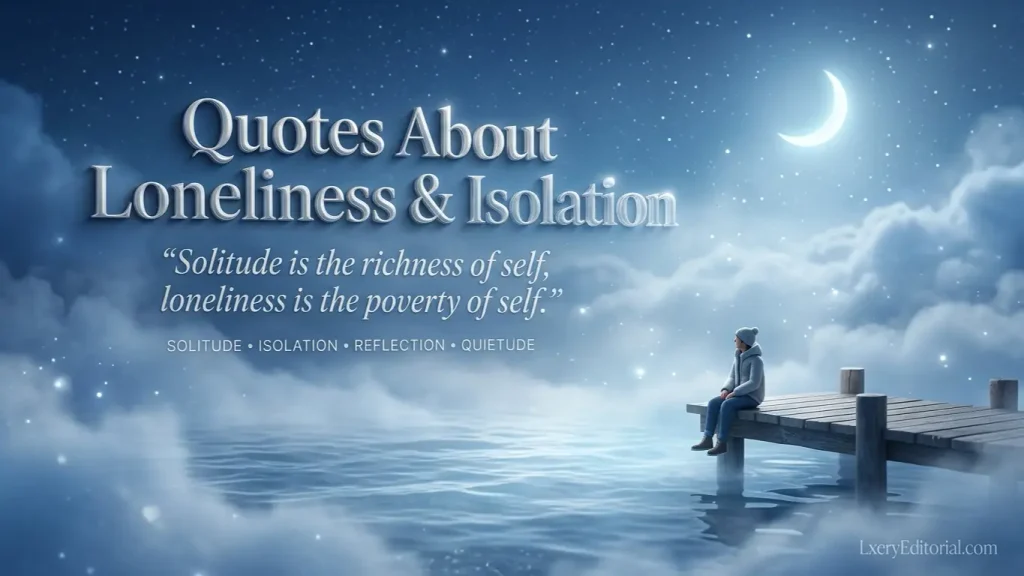
Loneliness affects almost everyone on the ranch, regardless of age, race, gender, or social position. Steinbeck presents isolation as a painful human condition that can make people desperate for even a brief moment of connection.
10. “A guy needs somebody—to be near him.”
Speaker: Crooks
Context: Chapter 4
Crooks explains to Lennie why people struggle when they have no one to talk to or trust.
Meaning: The statement presents companionship as a basic human need. Crooks has books and a room of his own, but neither can replace meaningful human contact.
11. “I tell ya a guy gets too lonely an’ he gets sick.”
Speaker: Crooks
Context: Chapter 4
Crooks describes the emotional damage caused by prolonged isolation.
Meaning: His words suggest that loneliness affects more than a person’s mood. It can undermine hope, confidence, and the ability to feel connected to the world.
12. “Why can’t I talk to you? I never get to talk to nobody. I get awful lonely.”
Speaker: Curley’s wife
Context: Chapter 5
Curley’s wife speaks openly about her isolation when she finds Lennie in the barn.
Meaning: Although the ranch workers often treat her as a source of trouble, this moment reveals her loneliness. Steinbeck invites readers to look beyond her reputation and recognize the person trapped behind it.
Crooks Quotes About Dreams and Discrimination
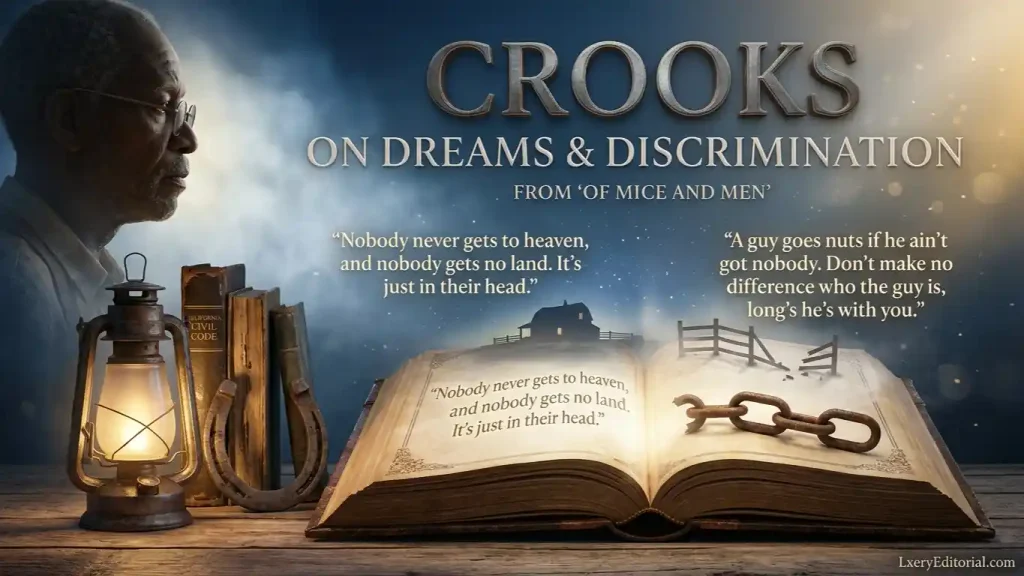
Crooks is isolated because of racism and lives separately from the other ranch workers. His experiences give him a skeptical view of promises about equality and opportunity. Through Crooks, Steinbeck shows that dreams are shaped not only by personal ambition but also by the barriers society creates.
13. “Nobody never gets to heaven, and nobody gets no land.”
Speaker: Crooks
Context: Chapter 4
Crooks responds to Lennie’s farm dream by comparing it to the hope of reaching heaven.
Meaning: His words reflect years of watching workers imagine a better future without achieving it. He doubts the dream because experience has taught him that hope does not guarantee opportunity.
14. “I seen too many guys with land in their head. They never get none under their hand.”
Speaker: Crooks
Context: Chapter 4
Crooks explains that many ranch workers carry dreams of owning land, but few turn those dreams into reality.
Meaning: The contrast between land “in their head” and land “under their hand” highlights the difference between imagination and ownership. It challenges the belief that hard work alone is enough to overcome poverty and discrimination.
15. “You got no right to come in my room. This here’s my room.”
Speaker: Crooks
Context: Chapter 4
Crooks initially resists Lennie entering his private space.
Meaning: His room is one of the few places where he has control. The scene shows how deeply exclusion has affected him and how strongly he protects the small amount of independence he possesses.
Candy and His Dog: Quotes About Aging and Mercy

Candy’s relationship with his old dog introduces questions about dignity, dependence, and the treatment of those who are no longer considered useful. His regret later becomes important to understanding George’s final decision.
16. “I ought to of shot that dog myself, George. I shouldn’t ought to of let no stranger shoot my dog.”
Speaker: Candy
Context: Chapter 3
After Carlson shoots Candy’s old dog, Candy tells George that he regrets allowing another man to do it.
Meaning: Candy’s regret is about more than the dog’s death. He feels he surrendered responsibility for a companion he had loved for years. The moment foreshadows George’s decision to take responsibility for Lennie’s fate.
17. “You hadda, George. I swear you hadda.”
Speaker: Slim
Context: Chapter 6
Slim comforts George after Lennie’s death.
Meaning: Slim’s words frame George’s action as an act of mercy in a situation with no easy solution. Readers may still question the decision, but Slim recognizes the emotional burden George has carried and offers him compassion.
Curley’s Wife Quotes About Broken Dreams

Curley’s wife is never given a personal name in the novella. This detail reinforces how others define her through her marriage rather than through her individual hopes. Her conversation with Lennie reveals a dream that never became reality.
18. “Coulda been in the movies, an’ had nice clothes—all them nice clothes like they wear.”
Speaker: Curley’s wife
Context: Chapter 5
Curley’s wife tells Lennie about her former hope of becoming a movie actress.
Meaning: Her dream represents a different version of the American Dream. She wanted recognition, independence, and a life beyond the ranch. Her confession helps readers see her as a lonely person whose ambitions have been disappointed.
19. “I coulda made somethin’ of myself.”
Editorial note: Verify this exact wording against your chosen edition before including it as a direct quotation. If the wording cannot be confirmed, use the verified movie-dream passage above instead.
Meaning: The idea behind this statement is central to Curley’s wife’s character: she looks back on the life she might have lived and feels trapped by the one she has.
Quotes About Rabbits and Symbolism

The rabbits are among the novella’s most recognizable symbols. They represent Lennie’s longing for softness and comfort, but they also stand for the larger dream that George and Lennie share. Their repeated appearance reminds readers how fragile that dream is.
20. “I remember about the rabbits, George.”
Speaker: Lennie Small
Context: The final scene, Chapter 6
As George prepares to shoot Lennie, Lennie returns to the familiar dream of tending rabbits on their own farm.
Meaning: The rabbits have become a symbol of safety and happiness for Lennie. George’s decision to repeat the dream in Lennie’s final moments makes the ending both tender and devastating.
21. “The best laid schemes o’ Mice an’ Men / Gang aft agley.”
Speaker: Robert Burns, from “To a Mouse” (1785)
Context: The poem that inspired Steinbeck’s title
Burns’s poem reflects on how carefully made plans can go wrong. Steinbeck uses its central idea to frame George and Lennie’s failed dream.
Meaning: The allusion connects the novella to a broader truth about human vulnerability. Even sincere, carefully nurtured plans can be destroyed by circumstances people cannot fully control.
Quotation note: Confirm the punctuation and spelling of Burns’s lines against the edition of the poem you cite.
Quotes About the Tragic Ending

The ending brings together the novella’s central themes: loyalty, responsibility, mercy, and the destruction of hope. George must make an unbearable choice, while the other ranch workers struggle to understand the grief that follows.
22. “Now what the hell ya suppose is eatin’ them two guys?”
Speaker: Carlson
Context: Chapter 6, the closing scene
Carlson asks this question after Slim leads the devastated George away.
Meaning: Carlson’s inability to understand their grief creates a powerful contrast with Slim’s compassion. The story ends by showing how a rare friendship can be lost in a world that often fails to recognize emotional suffering.
Why the ending matters
George’s decision is not presented as a simple victory or an uncomplicated act of kindness. Lennie’s death destroys their shared future, while George must live with the consequences of his choice. Candy’s earlier regret over his dog helps explain why George does not leave Lennie’s fate entirely to the other men.
The ending also returns the story to its opening setting near the river. This circular structure makes the conclusion feel inevitable while emphasizing how much has changed emotionally since the two men first arrived.
The Most Important Of Mice and Men Quotes at a Glance
| Theme | Character or source | What it reveals |
| American Dream | George | Hope for independence and a home |
| Friendship | Lennie | Mutual care and belonging |
| Loneliness | Crooks | The human need for companionship |
| Discrimination | Crooks | The barriers created by racism |
| Broken dreams | Curley’s wife | The pain of lost opportunity |
| Aging and responsibility | Candy | Fear of becoming unwanted |
| Mercy and grief | George and Slim | The moral cost of difficult choices |
| Symbolism | The rabbits | Lennie’s hope for safety and happiness |
| Failed plans | Robert Burns | The uncertainty of human hopes |
| Emotional indifference | Carlson | The inability to understand another person’s grief |
Frequently Asked Questions
Who wrote Of Mice and Men, and when was it published?
John Steinbeck wrote Of Mice and Men, which was published in 1937. The novella follows two migrant ranch workers during the Great Depression and explores friendship, poverty, loneliness, and the struggle to build a better life.
What is the most famous quote from Of Mice and Men?
One of the best-known passages is George’s description of ranch workers as lonely people who have no family or permanent home. It is memorable because it establishes the loneliness that makes his friendship with Lennie so important.
What does the title Of Mice and Men mean?
The title refers to Robert Burns’s poem “To a Mouse.” Its central idea is that even carefully made plans can go wrong. This connects directly to George and Lennie’s dream of owning a farm, which never becomes reality.
Why are the rabbits important in Of Mice and Men?
The rabbits symbolize Lennie’s hope for a peaceful, secure future. They also represent the farm that George and Lennie imagine owning together. The dream comforts Lennie, but its destruction makes the ending more tragic.
Why is friendship important in Of Mice and Men?
Friendship gives George and Lennie companionship and a sense of belonging in a world where most ranch workers are isolated. Their relationship challenges the loneliness of migrant life, even as it brings difficult responsibilities.
What does Crooks teach Lennie about dreams?
Crooks argues that many workers dream of owning land but never achieve it. His skepticism highlights the gap between hope and reality, especially for people who face poverty and discrimination.
Why does George kill Lennie at the end?
George kills Lennie before Curley’s group can reach him. Slim interprets George’s action as necessary under the circumstances, but the ending remains morally complex. It forces readers to consider responsibility, mercy, loyalty, and the terrible choices people may face.
What is the main message of Of Mice and Men?
The novella explores how people need companionship and hope, even when poverty, discrimination, and circumstances threaten their dreams. Steinbeck shows both the comfort friendship can provide and the devastating consequences of a world that leaves vulnerable people with few choices.
A Final Word
Of Mice and Men remains powerful because its characters want things that still matter: a place to belong, a friend who cares, a chance to live independently, and a future that feels worth working toward.
George and Lennie’s dream of a farm gives them hope, but the novella asks readers to look beyond the dream itself. It asks what happens when people are denied opportunity, when loneliness becomes unbearable, and when love and responsibility lead to painful choices.
From Crooks’s doubts to Candy’s regret and Slim’s compassion, Steinbeck shows that every character carries a private struggle. Their stories remind us that friendship can make life more bearable, even when it cannot protect us from every loss.
Editorial and quotation note
The quotations in this article should be checked against the specific edition of Of Mice and Men used for publication. Spelling, punctuation, and page numbers may differ by edition. Robert Burns’s lines come from “To a Mouse,” not from Steinbeck’s novella. For educational accuracy, provide chapter references and cite reliable literary references where appropriate.

Mustansar Abbas is a writer and author of the article “LuxaryEditorial” He is passionate about creating meaningful and engaging content that connects with readers through clear ideas and thoughtful expression.