

Macduff’s most powerful quotes in Macbeth reveal the devastating cost of tyranny, the importance of loyalty, and the courage to face grief honestly.
From his horror at King Duncan’s murder to his determination to defeat Macbeth, Macduff represents a different kind of strength: love for his country, loyalty to justice, and the willingness to acknowledge personal pain.
In this guide, you’ll discover 20 memorable Macduff quotes from William Shakespeare’s Macbeth, with their context, meanings, and significance. Whether you’re studying the play, preparing an essay, or exploring its themes, these lines offer valuable insights into courage, grief, ambition, masculinity, and justice.
Quick Guide to the Best Macduff Quotes

| Theme | Quote to Remember | Main Meaning |
| Horror | “O horror, horror, horror!” | The shock of Duncan’s murder |
| Loyalty | “I am not treacherous.” | Honesty when trust is uncertain |
| Patriotism | “Bleed, bleed, poor country!” | Scotland’s suffering under tyranny |
| Grief | “He has no children. All my pretty ones?” | A father’s devastating loss |
| Manhood | “But I must also feel it as a man.” | Grief and strength can coexist |
| Revenge | “Turn, hellhound, turn!” | Confronting a cruel enemy |
| Justice | “My voice is in my sword” | Acting when words are insufficient |
| Fate | “Macduff was from his mother’s womb / Untimely ripped.” | The truth behind the witches’ prophecy |
1. Macduff Quotes on Loyalty and Duncan’s Murder
Macduff’s response to King Duncan’s murder establishes his horror at the violence that has disrupted Scotland. In Act 2, Scene 3, he discovers the king’s body and immediately calls attention to the terrible crime.
1. “O horror, horror, horror! Tongue nor heart / Cannot conceive nor name thee!”
Act 2, Scene 3
Macduff speaks these words after discovering Duncan’s murder. The repeated word “horror” conveys shock so intense that ordinary language seems unable to express it.
His reaction contrasts with the political deception that follows the murder. While Macbeth attempts to control the situation and protect his position, Macduff responds with genuine alarm at the destruction of a king and the trust surrounding him.
Meaning: Some acts of evil are so shocking that words struggle to express their full impact.
2. “Confusion now hath made his masterpiece.”
Act 2, Scene 3
Macduff describes Duncan’s murder as the ultimate triumph of disorder. The word “confusion” suggests more than personal distress; it reflects the breakdown of the political and moral order that holds Scotland together.
Duncan’s death also violates the sacred status associated with kingship in Shakespeare’s world. Macduff’s reaction helps establish that the murder threatens the stability of the entire kingdom, not merely the life of one man.
Meaning: When justice and order collapse, the consequences can spread throughout a society.
3. “Approach the chamber and destroy your sight / With a new Gorgon.”
Act 2, Scene 3
Macduff uses an image from Greek mythology to describe the horror awaiting Macbeth and Lennox. A Gorgon, especially Medusa, was associated with a terrifying gaze that could turn people to stone.
By comparing the sight of Duncan’s body to a Gorgon, Macduff suggests that the murder scene is almost too terrible to witness. He urges the others to see the truth for themselves rather than expecting him to describe it adequately.
Meaning: Some sights are so disturbing that language alone cannot communicate their full horror.
4. “O gentle lady, / ’Tis not for you to hear what I can speak.”
Act 2, Scene 3
Macduff says this when Lady Macbeth asks what has happened. He continues by explaining that repeating the news in a woman’s ear would be devastating.
The exchange reflects the gender expectations of Shakespeare’s period, when men were often expected to shield women from distressing information. It also creates dramatic irony: the audience knows that Lady Macbeth has helped plan Duncan’s murder, although Macduff does not know her role.
His words therefore reveal both his concern for another person’s feelings and the limits of his understanding of the situation.
Meaning: People may make assumptions about others without knowing the truth hidden beneath appearances.
2. Macduff Quotes on Patriotism and Scotland’s Suffering

Macduff’s loyalty to Scotland becomes especially clear in Act 4, Scene 3. While speaking with Malcolm in England, he explains that his opposition to Macbeth is driven by concern for his suffering homeland.
5. “Hold fast the mortal sword and, like good men, / Bestride our downfall’n birthdom.”
Act 4, Scene 3
Malcolm initially suggests that they should find a quiet place to grieve for Scotland. Macduff instead urges him to take up arms and defend their country.
The phrase “downfall’n birthdom” refers to the homeland they share. By imagining himself and Malcolm standing protectively over Scotland, Macduff presents patriotism as an active responsibility rather than a feeling expressed through words alone.
His speech also recognizes the suffering of ordinary people, including widows and orphans, under Macbeth’s rule.
Meaning: Love for your country means taking responsibility when its people are suffering.
6. “I am not treacherous.”
Act 4, Scene 3
Macduff gives this direct answer when Malcolm suspects that he may be working for Macbeth. Malcolm fears that trusting the wrong person could lead to his death and prevent Scotland’s liberation.
Macduff’s brief denial reflects the seriousness of the situation. His loyalty must be tested because deception has become a central feature of Macbeth’s rule.
The line also contrasts with Macbeth’s own conduct. Macbeth once appeared honorable, but his ambition has led him into murder and betrayal.
Meaning: Honesty becomes especially important when fear and deception make trust difficult.
7. “Bleed, bleed, poor country!”
Act 4, Scene 3
Macduff imagines Scotland as a wounded body losing blood under Macbeth’s tyranny. The repetition of “bleed” emphasizes the country’s continuing suffering and makes the political crisis feel painfully personal.
The image also connects with the wider tragedy. Macbeth’s pursuit of power has harmed families, encouraged violence, and weakened the bonds that once held the kingdom together.
Macduff’s grief for Scotland is therefore not simply disappointment with a ruler. It is sorrow for a nation whose people are paying the price for one man’s ambition.
Meaning: A ruler’s cruelty can be measured by the suffering imposed on the people under that rule.
8. “Boundless intemperance / In nature is a tyranny.”
Act 4, Scene 3
During Malcolm’s test of Macduff’s loyalty, the two men discuss the dangers of uncontrolled desire. Macduff argues that excessive appetites can become a form of tyranny, especially when someone in power refuses to restrain them.
The observation connects with Macbeth’s ambition. His desire for the crown does not end when he becomes king. Instead, he commits further acts of violence because he cannot accept the possibility of losing power.
Macduff’s words suggest that a ruler’s private character matters because uncontrolled desires can eventually damage the entire country.
Meaning: When desire has no limits, it can become destructive to both individuals and society.
9. “Not in the legions / Of horrid hell can come a devil more damned / In evils to top Macbeth.”
Act 4, Scene 3
Macduff speaks these words after Malcolm claims that his own imagined vices would make him a worse king than Macbeth. Macduff struggles to believe that anyone could be more destructive than the ruler who has brought Scotland so much suffering.
The reference to the “legions” of hell communicates the intensity of his judgment. He sees Macbeth’s cruelty as extreme even when compared with the play’s most frightening images of evil.
The exchange also reveals Macduff’s concern about leadership. He does not want Scotland to escape one tyrant only to fall under another.
Meaning: A leader’s cruelty can become so destructive that people struggle to imagine anything worse.
10. “This avarice / Sticks deeper, grows with more pernicious root / Than summer-seeming lust.”
Act 4, Scene 3
Macduff compares greed with lust and argues that greed can become more deeply rooted and harmful. His words form part of Malcolm’s test, during which Malcolm describes himself as an unsuitable future king.
The image of a growing root suggests that destructive desires can spread over time. A person who constantly seeks more power, wealth, or control may become increasingly unwilling to recognize limits.
Macbeth’s ambition provides a powerful example. His desire to secure his crown leads him to commit further violence, making his position more destructive rather than more secure.
Meaning: Greed can become dangerous when it grows unchecked and begins to control a person’s decisions.
11. “O Scotland, Scotland!”
Act 4, Scene 3
Macduff cries out for Scotland after Malcolm describes himself as unfit to rule. Believing that Malcolm may be another dangerous leader, Macduff fears that his homeland has no trustworthy path out of its suffering.
The short exclamation communicates despair without requiring a long explanation. His concern is not about winning a political argument or advancing his own position. He wants a ruler who can end the violence and restore stability.
The moment reinforces Macduff’s role as a character whose loyalty extends beyond his personal interests.
Meaning: When a country suffers, uncertainty about its future can become a source of deep grief.
12. “Stands Scotland where it did?”
Act 4, Scene 3
When Ross arrives from Scotland, Macduff asks whether the country remains as it was. The question reveals how deeply he worries about the people and homeland he has left behind.
Ross’s response describes a nation overwhelmed by suffering, where violence and death have become increasingly common. Macduff’s question therefore prepares the audience for the painful news that follows, including the murder of his own family.
The line also reminds readers that political tyranny is not an abstract problem. It changes daily life and creates fear for people far beyond the ruler’s immediate circle.
Meaning: The questions we ask first often reveal what matters most to us.
3. Macduff Quotes on Grief and Family
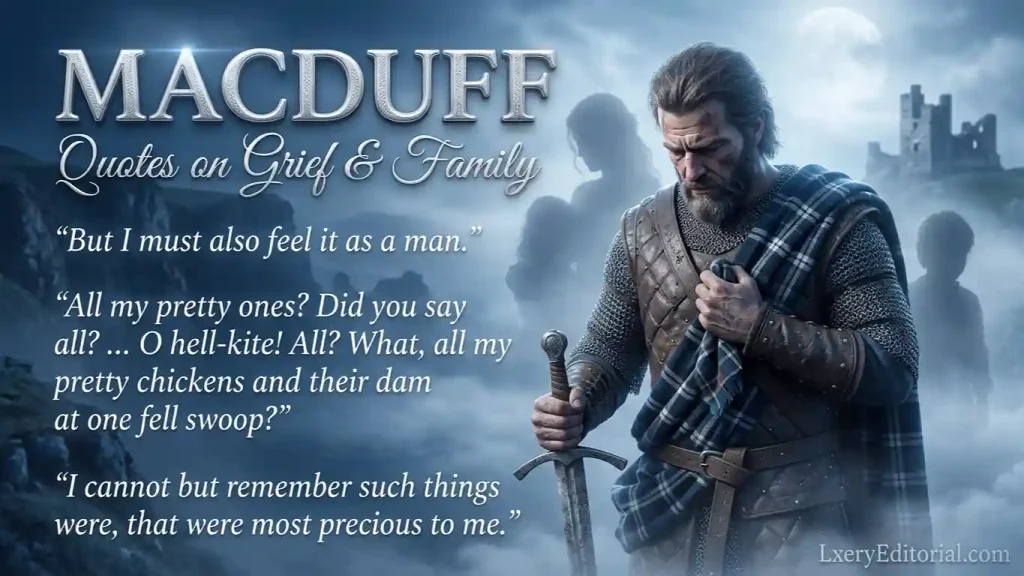
Macduff’s most emotional scene occurs in Act 4, Scene 3, when Ross tells him that Macbeth’s men have murdered his wife, children, and household.
This news changes the personal meaning of Macduff’s struggle. He already wants to free Scotland from tyranny, but now he must face a devastating loss that cannot be undone.
13. “He has no children. All my pretty ones? / Did you say ‘all’? O hell-kite! All?”
Act 4, Scene 3
Macduff struggles to accept that all his children have been killed. The repeated question “All?” conveys disbelief as he attempts to understand the full extent of the loss.
The opening phrase, “He has no children,” is often understood as Macduff bitterly reflecting on Macbeth’s apparent lack of comparable parental loss. The precise implication of the line is open to interpretation, but the surrounding passage clearly reveals a father overwhelmed by grief.
The image of his children as “pretty ones” makes the moment especially painful. Shakespeare shifts attention away from political conflict and toward the suffering of a family destroyed by a tyrant’s actions.
Meaning: Grief can make devastating news feel impossible to accept, especially when it concerns the people we love most.
14. “But I must also feel it as a man.”
Act 4, Scene 3
Malcolm urges Macduff to respond to his loss like a man by turning grief into anger. Macduff agrees to act, but he refuses to accept that manhood requires him to hide his feelings.
This is one of the most significant lines in the play because it challenges the idea that strength means emotional silence. Macduff recognizes that his grief is inseparable from his love for his wife and children.
His response does not make him less courageous. Instead, it gives his determination a deeply personal meaning.
Meaning: Real strength allows a person to acknowledge grief while still finding the courage to move forward.
15. “Sinful Macduff, / They were all struck for thee!”
Act 4, Scene 3
Macduff blames himself for his family’s deaths because he left Scotland to seek help against Macbeth. He believes that his absence made his loved ones vulnerable, even though Macbeth and his followers are responsible for the murders.
His words reveal the painful guilt that can follow a devastating loss. Macduff struggles to separate his decision to leave from the violence inflicted on his family.
This reaction also makes his character more complex. He is not simply a fearless opponent of Macbeth; he is a grieving person who questions his own choices and feels the weight of what has happened.
Meaning: After a terrible loss, people may blame themselves even when they did not cause the tragedy.
16. “O, I could play the woman with mine eyes / And braggart with my tongue!”
Act 4, Scene 3
Macduff acknowledges that he could weep and speak angrily about his loss, but he asks heaven to bring him face-to-face with Macbeth instead.
The phrase “play the woman” reflects the gender assumptions of Shakespeare’s time, when women were often stereotyped as more emotional than men. The line also needs to be read alongside Macduff’s earlier declaration that he must feel his grief as a man.
Together, these passages create a more complicated picture of masculinity than the simple expectation that men should suppress their emotions. Macduff feels his loss deeply while also seeking the opportunity to confront the person responsible.
Meaning: Grief and courage can exist together, even when pain makes the next step difficult.
4. Macduff Quotes on Revenge and Justice
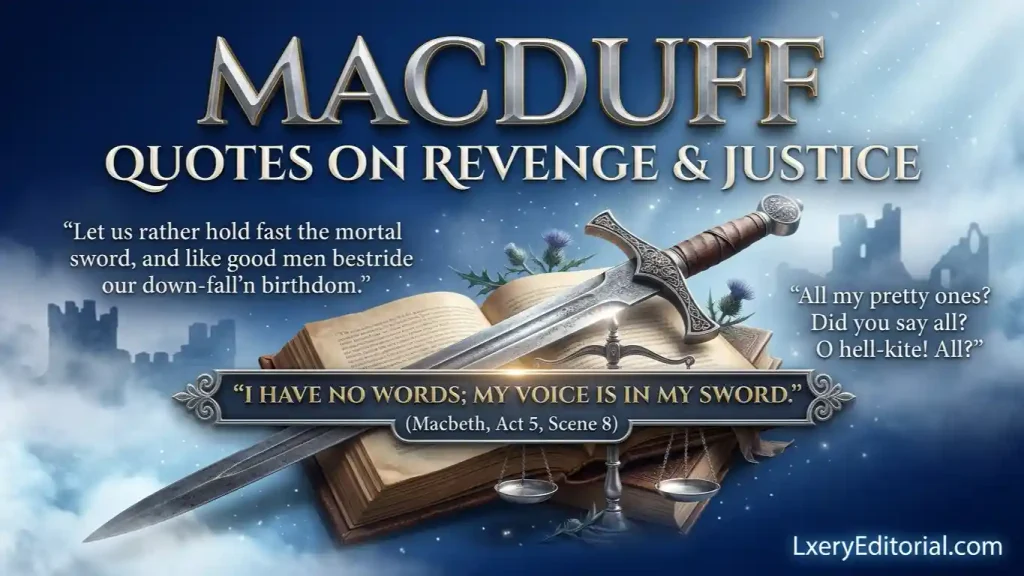
In Act 5, Scene 8, Macduff finally confronts Macbeth. His language becomes short, direct, and forceful, reflecting the change from grief and uncertainty to a decisive struggle against the man responsible for his family’s deaths and Scotland’s suffering.
17. “Turn, hellhound, turn!”
Act 5, Scene 8
Macduff calls Macbeth a “hellhound” and demands that he turn to face him. Macbeth has avoided Macduff because he knows the witches warned him to beware the Thane of Fife.
The insult associates Macbeth with evil rather than rightful leadership. The repeated command also makes the confrontation feel unavoidable: Macduff has come to face the man whose actions have devastated his family and country.
His words express anger, but they also show that he is no longer willing to let Macbeth escape accountability.
Meaning: Wrongdoing cannot always be avoided; eventually, it must be confronted.
18. “I have no words; / My voice is in my sword, thou bloodier villain / Than terms can give thee out.”
Act 5, Scene 8
Macduff declares that words cannot adequately express his judgment of Macbeth. His “voice” is now in his sword, meaning that he intends to act rather than continue arguing.
This moment contrasts with the deception and misleading promises that shape much of the play. Macbeth has relied on violence and false confidence to preserve his position, but Macduff’s response is direct and decisive.
The passage also connects his personal grief with his political purpose. He wants to confront Macbeth not only because his family has been murdered, but because the tyrant’s rule has brought suffering to Scotland.
Meaning: When words can no longer achieve justice, decisive action may become necessary.
19. “Despair thy charm, / And let the angel whom thou still hast served / Tell thee Macduff was from his mother’s womb / Untimely ripped.”
Act 5, Scene 8
Macduff reveals that he was delivered from his mother’s womb before a natural birth. This explains the loophole in the witches’ prophecy that no man “of woman born” could harm Macbeth.
Macbeth has treated the prophecy as a guarantee of safety. Macduff’s revelation exposes the danger of interpreting reassuring words too confidently without considering their full meaning.
The phrase “untimely ripped” is generally understood to refer to a birth by Caesarean section or another surgical delivery. The dramatic point is not the medical procedure itself, but the way Macduff’s birth defeats Macbeth’s interpretation of the prophecy.
The revelation also marks the collapse of Macbeth’s confidence. The promises he trusted no longer protect him from the consequences of his actions.
Meaning: Overconfidence can make people overlook the uncertainty hidden within promises that seem reassuring.
20. “Hail, King! for so thou art. Behold, where stands / Th’ usurper’s cursèd head. Time is free.”
Act 5, Scene 9
After Macbeth’s death, Macduff greets Malcolm as king and presents Macbeth’s severed head as proof that the tyrant has fallen. His words mark the end of Macbeth’s rule and the beginning of a new political order.
The declaration “Time is free” expresses relief that Scotland is no longer under Macbeth’s immediate tyranny. Earlier, Macduff mourned his country as a wounded nation. Now he can announce that the threat has been removed and Malcolm can take the throne.
The ending does not erase the suffering that came before it. Macduff’s family cannot be restored, and Scotland has endured immense violence. Nevertheless, Macbeth’s defeat creates the possibility of recovery and more just leadership.
Meaning: Ending tyranny can open the way to a new beginning, even when the damage of the past cannot be undone.
What Makes Macduff an Important Character in Macbeth?

Macduff serves as a moral contrast to Macbeth, but he is not simply a flawless hero. His decision to leave his family in Scotland while seeking Malcolm’s help exposes the personal risks of political resistance. His later guilt shows how deeply he feels the consequences of that decision.
Three qualities make him particularly important to the play.
1. Loyalty to Scotland
Macduff places the welfare of his country above personal ambition. He recognizes that Macbeth’s rule has damaged Scotland and joins Malcolm in the effort to remove the tyrant.
His patriotism is demonstrated through action rather than empty declarations. He risks his safety because he believes the country needs a better future.
2. Emotional honesty
Macduff’s grief after the murder of his family challenges the belief that men must suppress their emotions to appear strong. His declaration that he must also feel his loss as a man makes sorrow a natural part of courage rather than its opposite.
This is one reason his character remains meaningful to modern readers. He demonstrates that acknowledging pain does not prevent someone from taking responsibility or acting bravely.
3. Courage and responsibility
Macduff confronts Macbeth despite the danger and helps restore Malcolm to the throne. His courage is not simply a willingness to fight; it is also a willingness to face painful truths about his country, his family, and himself.
Together, these qualities make him a powerful counterpoint to Macbeth, whose ambition gradually destroys his judgment, relationships, and kingdom.
Frequently Asked Questions About Macduff Quotes
Who is Macduff in Macbeth?
Macduff is the Thane of Fife, a Scottish nobleman who opposes Macbeth after Duncan’s murder. He joins Malcolm in the effort to reclaim Scotland and eventually kills Macbeth in the final confrontation.
What is Macduff’s most famous quote?
One of Macduff’s best-known lines is “But I must also feel it as a man,” spoken after he learns that his family has been murdered. The line expresses his belief that grief is compatible with courage and manhood.
Another memorable passage is his revelation that he was “from his mother’s womb / Untimely ripped,” which exposes the flaw in Macbeth’s understanding of the witches’ prophecy.
What does “But I must also feel it as a man” mean?
The line means that Macduff believes men can acknowledge grief without becoming weak. Although Malcolm urges him to turn his sorrow into anger, Macduff insists that he must also feel the loss of the people he loved.
Why does Macduff want revenge on Macbeth?
Macduff wants to end Macbeth’s tyranny and help restore peace to Scotland. After Macbeth orders the murder of his family, his opposition also becomes deeply personal. His final confrontation combines his desire to avenge his loved ones with his determination to end Macbeth’s rule.
How does Macduff help restore order in Scotland?
Macduff joins Malcolm’s campaign against Macbeth, confronts Macbeth in battle, and kills him. He then presents Macbeth’s head and recognizes Malcolm as king, marking the end of the tyrant’s rule.
What themes do Macduff’s quotes reveal?
Macduff’s words explore loyalty, patriotism, grief, masculinity, justice, ambition, and the consequences of tyranny. His speeches show both the suffering caused by Macbeth’s actions and the courage required to oppose them.
Why is Macduff’s grief important to the play?
Macduff’s grief makes the consequences of Macbeth’s ambition personal and immediate. Rather than presenting tyranny only as a political problem, Shakespeare shows how it destroys families and leaves survivors struggling with sorrow and guilt.
Is Macduff a hero in Macbeth?
Macduff is generally understood as one of the play’s heroic figures because he opposes Macbeth’s tyranny and helps restore Malcolm to the throne. However, his decision to leave his family behind also creates a moral complication, making him a more human and complex character.
Final Thoughts on Macduff Quotes
Macduff’s words in Macbeth show that courage is not limited to fighting an enemy or winning a battle. It can also mean speaking honestly, caring about a suffering country, acknowledging grief, and continuing to act when life becomes unbearable.
His journey begins with horror at Duncan’s murder, develops through concern for Scotland, and reaches its emotional peak when he learns that his family has been killed. In the final confrontation, he helps bring Macbeth’s rule to an end.
For students and readers, these 20 Macduff quotes provide a way to explore Shakespeare’s themes of loyalty, grief, masculinity, ambition, and justice. Macduff’s story reminds us that strength does not require the absence of emotion. It requires the courage to face the truth and act with purpose.
Editorial note: The quotations and scene references in this article follow the Folger Shakespeare Library text of Macbeth. Other editions may differ in spelling, punctuation, or scene numbering. If your website uses another edition, check the quotations and references against that text before publication.

Mustansar Abbas is a writer and author of the article “LuxaryEditorial” He is passionate about creating meaningful and engaging content that connects with readers through clear ideas and thoughtful expression.